The AI Burnout Paradox: When Productivity Tools Make Developers Miserable
- 6 minutes - Feb 12, 2026
- #ai#burnout#developer-experience#productivity#mental-health
Here’s an irony that nobody predicted: AI tools designed to make developers more productive are making some of them more miserable.
The promise was straightforward. AI handles the tedious parts of coding—boilerplate, repetitive patterns, documentation lookup—freeing developers to focus on the interesting, creative work. Less toil, more thinking. Less grinding, more innovating.
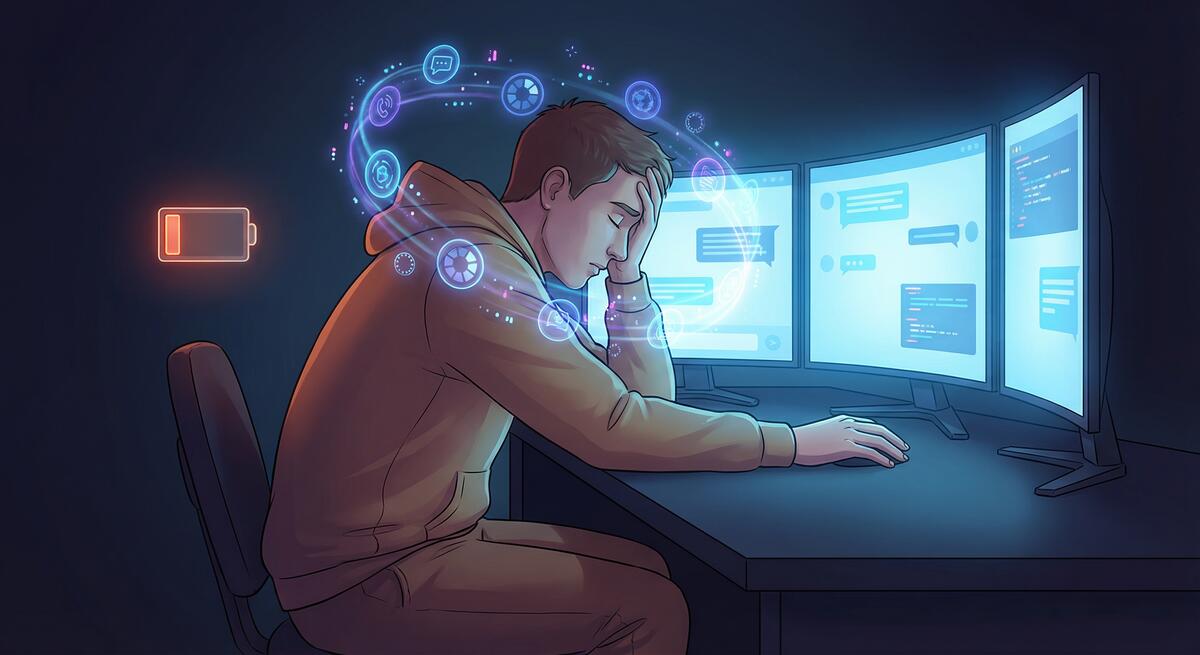
The reality is more complicated. Research shows that GenAI adoption is heightening burnout by increasing job demands rather than reducing them. Developers report cognitive overload, loss of flow state, rising performance expectations, and a subtle but persistent feeling that their work is being devalued.
This isn’t a universal experience—many developers genuinely love AI tools and feel more productive. But the burnout signal is real, it’s growing, and engineering leaders need to pay attention.
The New Cognitive Burdens
AI tools didn’t eliminate cognitive work. They transformed it.
From Flow to Fragmentation
Traditional coding has a rhythm. You think about a problem, design a solution, implement it, test it. With practice, this becomes a flow state—deep, focused, satisfying work.
AI tools break this rhythm. Instead of sustained implementation, you’re now in a loop of prompting, evaluating, accepting, rejecting, modifying, re-prompting. Each cycle is short. Each requires a different type of thinking than the last. The mechanical parts of coding—the parts you could do on autopilot while thinking about architecture—are gone. What replaces them is constant evaluation and decision-making.
The result is what researchers describe as “high-intensity cognitive bursts with no flow state.” You’re mentally active the entire time, but the activity is fragmented rather than sustained. It’s more like being interrupted every 30 seconds than working on a focused task.
Some developers thrive in this mode. Others find it exhausting in ways they can’t quite articulate. They’re working fewer hours but feeling more drained.
Invisible Mental Work
There’s a psychological burden to AI-assisted work that’s easy to miss: much of the valuable work developers do now feels unproductive.
Writing code feels productive. You can see progress on the screen. Characters appearing, functions taking shape, tests passing. The feedback loop is immediate and satisfying.
Reviewing AI-generated code doesn’t feel productive. You’re reading someone else’s work, checking for subtle issues, verifying correctness. This is high-value work—arguably higher value than writing the code—but it lacks the satisfying feedback loop. You’re spending energy without the visible reward.
Prompting and iterating with AI doesn’t feel productive either. You’re having a conversation, not building something. Even when the conversation produces useful output, the process feels passive compared to direct implementation.
The result: developers are doing more valuable work while feeling less productive. This perception gap creates dissatisfaction and self-doubt that contributes to burnout.
The Expectation Ratchet
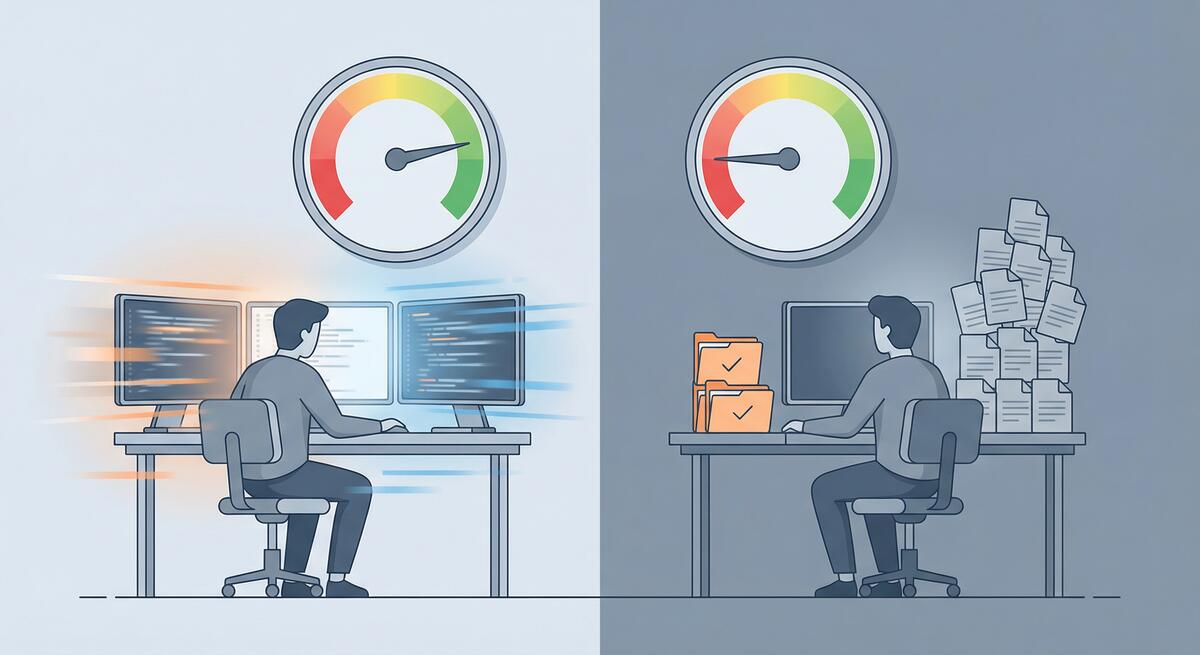
When AI tools make certain tasks faster, organizational expectations adjust. If AI-generated code means a developer can ship features 30% faster, the sprint plan fills that 30% with additional work rather than giving the developer breathing room.
This is the expectation ratchet: productivity gains are immediately consumed by increased demands, leaving developers on a faster treadmill rather than a more sustainable pace. The toil isn’t reduced—it’s replaced by different toil at higher volume.
Some organizations are explicit about this: “AI lets us do more with the same team.” Others do it unconsciously: sprints get more ambitious, backlogs grow, and deadlines tighten because “you have AI to help.”
Either way, the developer’s workload increases even as individual tasks get faster.
Devaluation Anxiety
There’s a deeper psychological impact that’s harder to quantify: the feeling that your work is being devalued.
When AI can write code that looks similar to what you write, it raises uncomfortable questions. Is my skill valuable? How long before I’m replaceable? If AI writes 30% of the code at Microsoft, how long before it writes 90%?
These questions create ambient anxiety that saps energy and motivation. Even developers who intellectually understand that their judgment and expertise remain valuable can feel emotionally uncertain about their future.
A Register article from January captured this bluntly: “AI’s grand promise: Less drudgery, more complexity, same (or lower) pay.” The fear isn’t just about job loss—it’s about the devaluation of craft in a profession where many people find identity and meaning.
The Numbers
The data supports what anecdotally many developers describe:
- A 2025 field study found developers using AI tools took 19% longer on tasks than those working without, suggesting productivity gains are more perceived than real in many contexts.
- Research shows GenAI adoption heightens burnout by increasing job demands.
- IBM documented time savings for specific tasks (59% faster documentation, 56% faster code explanation) but acknowledged these don’t consistently translate to overall productivity improvements.
- Context-switching between coding and prompting is emerging as a significant cognitive cost.
What Engineering Leaders Should Do
This isn’t a problem developers can solve alone. It requires organizational awareness and deliberate intervention.
Measure Developer Experience, Not Just Output
If you’re tracking lines of code, PRs merged, or story points completed, you’re measuring the wrong things. These metrics will look great as AI tools accelerate production, even as your team burns out.
Start measuring:
- Developer satisfaction surveys: Regular check-ins on how people feel about their work and tools.
- Flow time: How much uninterrupted focus time do developers actually get?
- Cognitive load indicators: Are developers reporting mental exhaustion? Context-switching fatigue?
- Voluntary attrition: Are people leaving? Exit interviews often reveal burnout that surveys miss.
Protect Focus Time
AI tools encourage rapid iteration. This is good for some work and terrible for others. Create explicit blocks of time where AI-free deep work is not just allowed but encouraged.
This might mean:
- “No-meeting, no-AI” blocks for architecture and design work
- Permission to turn off AI assistants when they’re not helping
- Recognition that some tasks are faster and better done without AI
Don’t Fill the Productivity Gap
If AI makes your team 20% faster, resist the urge to add 20% more work. Use some of that capacity for:
- Learning and skill development
- Technical debt reduction
- Exploratory work and prototyping
- Rest and recovery
Teams that reinvest productivity gains into sustainability perform better long-term than teams that ratchet up expectations.
Acknowledge the Emotional Dimension
Developers worried about their future relevance need honest conversation, not reassurance platitudes. Acknowledge that AI is changing the profession. Be specific about what your organization values in human developers. Invest in the skills that remain distinctly human: system design, judgment, creativity, mentorship.
And be honest about what you don’t know. Nobody knows exactly how AI will reshape software development over the next five years. Pretending otherwise doesn’t help.
Make AI Optional
Not every developer works better with AI tools. Not every task benefits from AI assistance. Making AI tools mandatory—or creating implicit pressure to use them—forces people into workflows that may not suit them.
Let developers choose when and how to use AI. Trust their judgment about their own productivity and well-being.
The Bigger Picture
AI tools are powerful. They genuinely help many developers do better work. But they’re also creating new forms of stress and cognitive burden that the industry hasn’t fully reckoned with.
The burnout paradox—tools that promise to reduce toil but increase exhaustion—is a warning sign. Not a warning to stop using AI tools, but a warning to use them thoughtfully, with attention to their human impact as well as their productivity metrics.
The developers who thrive with AI tools will be those who control the tools rather than being controlled by them. The organizations that thrive will be those that measure human wellbeing alongside human output.
Productivity without sustainability isn’t productivity. It’s borrowed time.