The Latest AI Code Security Benchmark Is Useful for One Reason
- 3 minutes - Mar 14, 2026
- #ai#security#llms#benchmarks#code-quality
The newest AI code security benchmark is worth reading, but probably not for the reason most people will share it.
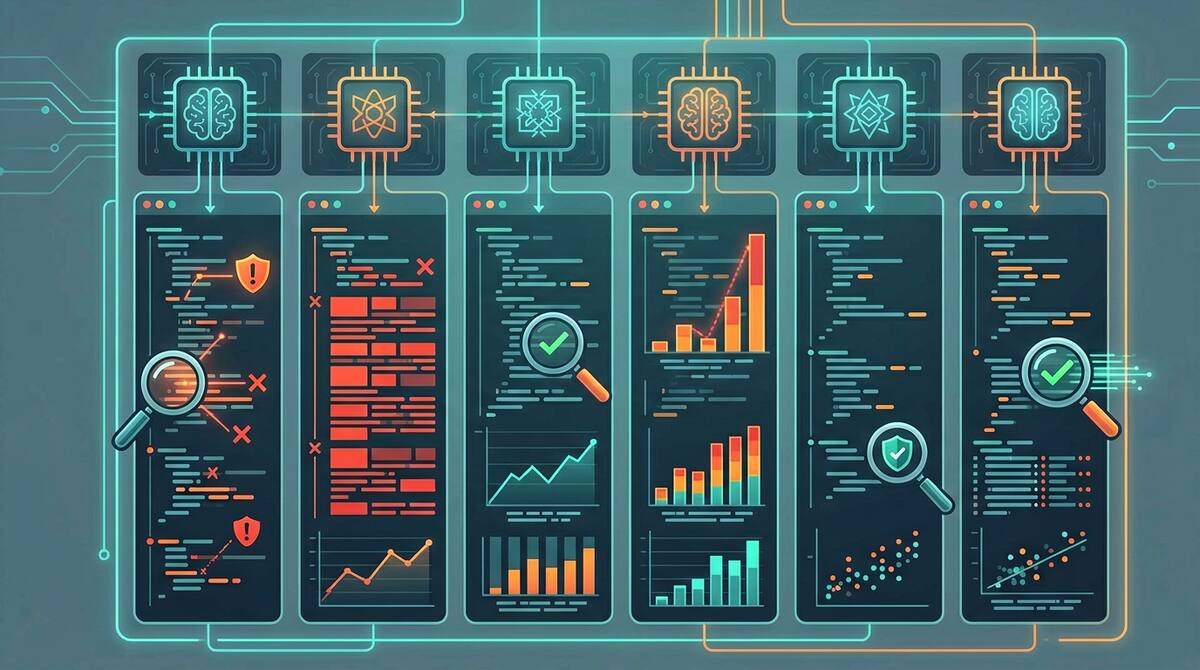
The headline result is easy to repeat: across 534 generated code samples from six leading models, 25.1% contained confirmed vulnerabilities after scanning and manual validation. GPT-5.2 performed best at 19.1%. Claude Opus 4.6, DeepSeek V3, and Llama 4 Maverick tied for the worst result at 29.2%. The most common issues were SSRF, injection weaknesses, and security misconfiguration.
Those rankings will get attention. They are not the most important takeaway.
What the Study Actually Proves
The most useful conclusion is that model quality has improved enough that performance differences are measurable, but not enough that any mainstream model is trustworthy without serious verification.
That is the operational lesson:
- the safest model in the study still produced vulnerable code nearly one time in five
- the gap between best and worst models was just over ten percentage points
- no language was universally safer across all models
In other words, model selection matters, but it does not solve the actual engineering problem. Choosing the “best” model does not remove the need for strong review, testing, and security validation.
Why Teams Misread Results Like This
Most teams want benchmark results to answer a procurement question: “Which model should we standardize on?”
That is understandable, but incomplete. Benchmarks like this are more useful for shaping policy than for declaring a single winner.
If 25.1% of generated outputs contain confirmed vulnerabilities, and even the best model still has a meaningful failure rate, then the right organizational response is not just “pick GPT-5.2.” It is:
- require security scanning on AI-generated changes
- raise review scrutiny on high-risk code paths
- separate model evaluation from deployment policy
- assume prompt quality and task framing will change results further in the wild
The benchmark is a reminder that you are buying probability distributions, not guarantees.
Why This Still Matters
None of this means benchmarks are useless. Quite the opposite.
They are useful because they help teams move beyond vibes. A lot of AI coding adoption still happens through anecdote: one engineer loves a model, another hates it, everyone generalizes from a handful of examples. Studies like this create a stronger baseline for discussing risk.
They also help expose patterns. In this study, SSRF and injection issues were especially common. That is practical information. Teams can use it to tighten code review checklists, tune scanners, and design targeted guardrails around the vulnerability classes AI tools seem most likely to generate.
The Better Question to Ask
Instead of asking, “Which model is safe?”, teams should ask:
What verification stack do we need if even the better models still fail this often?
That question leads to better investments:
- faster SAST and dependency scanning
- policy gates for security-critical files
- stronger repo instructions for sensitive areas
- explicit human review for auth, networking, and data-handling changes
- testing and validation tooling that can keep up with AI-generated volume
That last point matters most. The benchmark does not just describe model weakness. It describes a workflow mismatch: code generation is scaling faster than validation.
The Most Honest Reading
The current generation of coding models is good enough to be genuinely useful and still weak enough to create real security exposure. Both things are true.
That means teams should stop looking for a model choice that lets them relax. The real win condition is building a workflow where vulnerable output is cheap to catch before it becomes expensive to fix.
The benchmark is useful for one reason: it makes that tradeoff impossible to ignore.