From Code Writer to AI Orchestrator: The Changing Developer Role
- 8 minutes - Feb 5, 2026
- #ai#career#development#teams#future-of-work
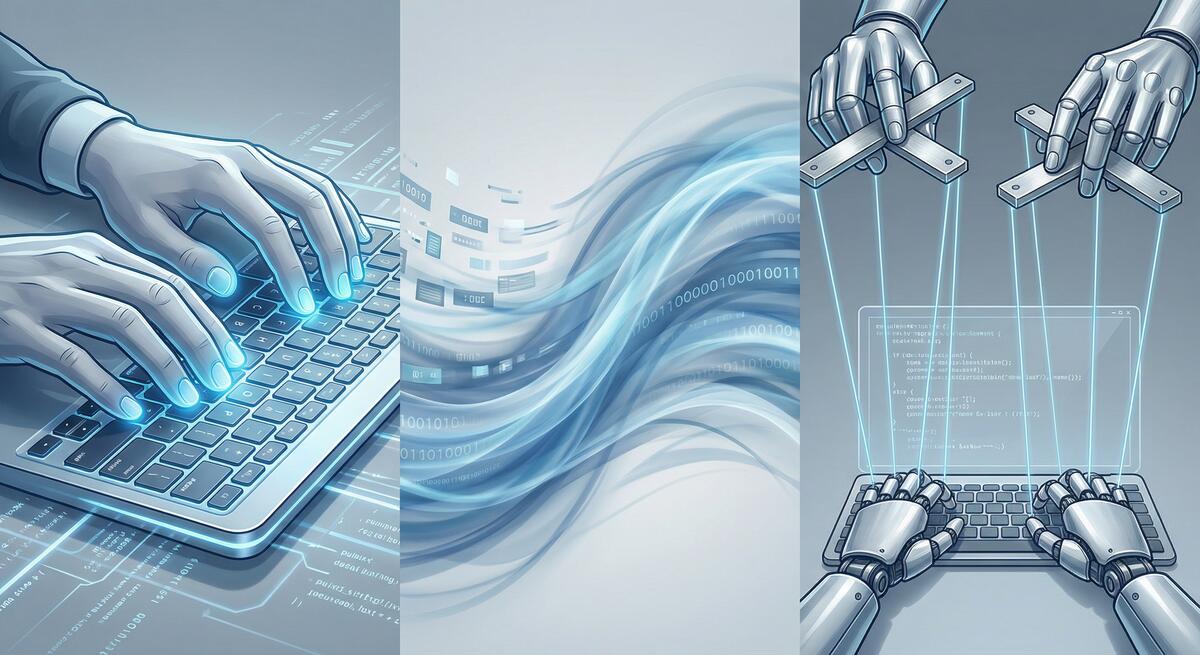
There’s a narrative circulating in tech circles: developers are evolving from “code writers” to “AI orchestrators.” The story goes that instead of typing code ourselves, we’ll direct AI agents that write code for us. Our job becomes coordination, review, and high-level direction rather than implementation.
It’s a compelling vision. It’s also significantly oversimplified.
Research shows that developers can currently “fully delegate” only 0-20% of tasks to AI. That’s not nothing, but it’s far from the wholesale transformation some predict. The reality of how developer roles are changing is more nuanced—and more interesting—than the hype suggests.
What “Orchestration” Actually Looks Like
Let’s start by understanding what AI orchestration means in practice, because it’s not what many people imagine.
Orchestration isn’t sitting back while AI does your job. It’s actively managing a collaboration where you and AI tools work together, each contributing different capabilities. Your day might look something like this:
Morning: You’re implementing a new feature. You describe the high-level approach to an AI assistant, which generates scaffolding code. You review it, spot issues with how it handles edge cases, and either fix them yourself or guide the AI toward a better approach.
Midday: You’re debugging a complex issue. The AI helps you search through logs and suggests potential causes, but you’re the one who understands the system well enough to identify the actual root cause. The AI then helps you write the fix, but you carefully review it before committing.
Afternoon: You’re doing code review on a colleague’s PR, which includes AI-generated code. You need to verify not just that it works, but that it fits the system’s architecture, handles edge cases correctly, and doesn’t introduce subtle bugs.
Late afternoon: You’re designing the architecture for an upcoming project. The AI can suggest patterns and generate examples, but you’re making the decisions about tradeoffs, constraints, and how the new system fits with existing infrastructure.
This is orchestration. It’s not passive. It’s a different kind of active work than pure implementation, but it’s still demanding.
Skills That Matter More Now
The shift toward orchestration changes which skills are most valuable. Some capabilities are becoming more important than ever.
System Thinking and Architecture
When AI handles more implementation details, your value increasingly comes from understanding the bigger picture. How do components fit together? What are the right abstraction boundaries? How will this system evolve?
AI tools are notoriously poor at architecture. They generate locally optimal code that doesn’t fit the global structure. Developers who can think at the system level—who understand how decisions in one area affect the whole—become more valuable, not less.
Code Review and Verification
If AI is generating more code, someone needs to verify it. And AI-generated code requires different review skills than human-written code.
Human code tends to fail in predictable ways: typos, missed edge cases, unclear naming. AI code tends to fail in different ways: plausible-looking but subtly wrong logic, hallucinated APIs, solutions that work for the test case but not the general case.
Effective reviewers need to adapt their approach. You can’t just skim for obvious errors; you need to verify that the code actually does what it appears to do. This is more cognitively demanding than traditional code review.
Prompting and Direction
Getting good output from AI tools is a skill. Clear, specific prompts with appropriate context produce better results than vague requests. Understanding what the AI does well and poorly helps you know when to use it and when to code manually.
This isn’t just about phrasing. It’s about understanding the AI’s capabilities, knowing how to provide context effectively, and recognizing when the AI is heading in the wrong direction.
Domain Expertise
AI tools have broad but shallow knowledge. They know a little about everything but don’t deeply understand your specific domain, your users, or your business constraints.
Deep domain expertise becomes more valuable as AI handles generic implementation. The developer who understands the healthcare regulations, the financial requirements, or the specific user needs can guide AI toward solutions that actually work in context.
Skills That Matter Less
Some skills are genuinely becoming less critical as AI capabilities improve.
Syntax Memorization
Knowing the exact syntax for every language and framework matters less when AI can generate syntactically correct code instantly. You still need to read and understand syntax, but memorizing every detail is less important.
Boilerplate Implementation
Standard patterns—CRUD operations, API endpoints, data transformations—are increasingly delegable to AI. Time spent on this kind of work decreases.
Documentation Lookup
Searching through documentation to find the right method or parameter is less necessary when AI can answer these questions directly. The time spent on routine lookup decreases.
Note what these have in common: they’re mechanical tasks that didn’t require much judgment. AI is best at automating work that was already somewhat algorithmic. The skills that remain valuable are those that require genuine understanding and decision-making.
What This Means for Engineering Managers
If you’re managing a team, the orchestration shift has implications for how you hire, train, and organize.
Hiring
The skills that predict success are shifting. Strong fundamentals still matter—you can’t review code you don’t understand—but the emphasis changes.
Look for:
- System thinking and architectural judgment
- Communication skills (prompting is communication)
- Critical evaluation ability (reviewing AI output)
- Adaptability and learning speed (tools are evolving rapidly)
- Domain expertise relevant to your work
Be cautious about:
- Over-weighting syntax expertise or language-specific knowledge
- Assuming AI fluency equals programming competence
- Hiring purely for AI tool experience without foundational skills
Training
Your team needs to develop new capabilities while maintaining foundational skills.
Invest in:
- Architecture and system design training
- Code review practices adapted for AI-generated code
- Effective AI tool usage (prompting, verification, knowing limitations)
- Domain knowledge deepening
Don’t abandon:
- Core programming fundamentals
- Debugging and troubleshooting skills
- Understanding of how things work under the hood
The risk is that over-reliance on AI tools causes skill atrophy in areas that still matter. Training should balance AI augmentation with foundational capability.
Team Structure
The orchestration model might affect how you organize work.
Consider:
- Developers might need more time for review and less time blocked for deep implementation
- Collaboration patterns might shift as AI handles some of the “solitary coding” work
- Senior developers might spend more time on architecture and review, less on implementation
- The ratio of senior to junior developers might shift (this is speculative and context-dependent)
Be careful about:
- Assuming you need fewer developers (the work changes, but there’s still plenty of it)
- Reorganizing too aggressively based on predictions that haven’t played out
- Treating AI as a replacement for mentorship and knowledge transfer
The 0-20% Reality
Let’s return to that research finding: developers can fully delegate only 0-20% of tasks to AI. This deserves unpacking.
“Fully delegate” means handing off a task and accepting the result without modification. Most AI-assisted work doesn’t look like this. Instead, it looks like:
- AI generates a first draft; human significantly modifies it
- Human writes the core logic; AI fills in boilerplate
- AI suggests an approach; human decides whether to use it
- Human and AI iterate together until the code is right
This is collaboration, not delegation. The AI is a highly capable tool that amplifies your work, but it’s not an independent agent that can take ownership of tasks.
The 0-20% that can be fully delegated tends to be:
- Highly repetitive tasks with clear patterns
- Well-documented problems with standard solutions
- Tasks where “good enough” is acceptable
- Work that can be easily verified
For everything else, you’re collaborating with AI, not delegating to it. And that collaboration still requires significant human effort, judgment, and skill.
What Isn’t Changing
Amid all this discussion of change, some things remain constant.
Software development is still about solving problems. The tools change, but the fundamental work of understanding requirements, designing solutions, and delivering value remains.
Judgment still matters. AI can generate options, but choosing the right option requires understanding context, tradeoffs, and consequences that AI doesn’t grasp.
Quality requires effort. Fast code isn’t the same as good code. AI can accelerate production, but ensuring quality still requires human attention.
Systems thinking wins. Understanding how things fit together remains the core skill. AI might help with pieces, but humans orchestrate the whole.
Looking Forward
The “code writer to AI orchestrator” framing isn’t wrong, but it’s incomplete. A better description: developers are becoming AI-augmented engineers, doing the same fundamental work with more powerful tools.
The transition is real but gradual. It’s not a revolution where everything changes overnight; it’s an evolution where capabilities expand and workflows adapt. Developers who understand this—who develop the skills for effective AI collaboration without abandoning fundamentals—will thrive.
For those worried about obsolescence: the demand for people who can build and maintain software systems isn’t going away. The specific tasks change, but the need for human judgment, creativity, and expertise remains.
For those excited about the possibilities: AI tools are genuinely making us more capable. Embrace them, learn to use them well, and focus on the skills that remain distinctly human.
The future of software development isn’t humans or AI. It’s humans and AI, working together, with humans still very much in charge of the parts that matter most.